Reviewed: The 2026 Nissan Armada Platinum Reserve - Houston, We Have a Solution.

By Jordan Marmara
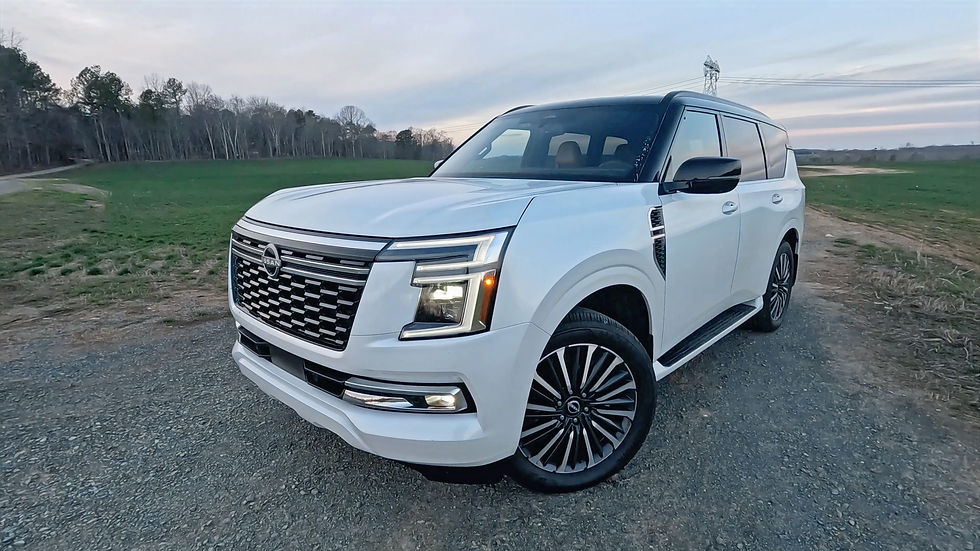
For decades, the full-size SUV segment has operated in a steady, albeit predictable, orbit around a few familiar celestial bodies. But with the launch of the 2026 Nissan Armada, Nissan has officially jettisoned its aging hardware and ignited a second stage designed to propel the brand into a domain long dominated by domestic titans. It’s a vehicle built for the suburban commander who needs to ferry a crew of eight through the asteroid belt of morning carpool lines while maintaining enough luxury to rival a first-class pod on a Martian cruiser.

The most radical departure from mission-as-usual occurs under the hood. Nissan has finally retired the 5.6-liter V8—an engine that sounded like a localized thunderstorm but lacked modern efficiency. In its place sits a high-output 3.5-liter twin-turbocharged V6. Delivering 425 horsepower and a massive 516 lb-ft of torque, this new heart provides the kind of low-end thrust usually reserved for heavy-lift rockets. To put that in perspective, the original Apollo Lunar Rover managed a top speed of about 8 mph, the Armada, meanwhile, hits 60 mph in roughly six seconds while maintaining an 8,500-pound towing capacity. It’s the perfect setup for the parent who spent their youth dreaming of Space Camp but now spends their weekends navigating the treacherous terrain of a crowded boat launch.

Step inside the "command module," and the transformation is even more stark. The dashboard is dominated by a massive dual-screen interface, providing 28.6 inches of digital real estate. In a display of just how far terrestrial tech has come, the processing power required to run the Armada’s infotainment and driver-assist systems is estimated to be over 100,000 times more powerful than the Apollo Guidance Computer that landed Neil Armstrong on the moon. The Platinum Reserve trim elevates this high-tech environment with open-pore wood and quilted leather seats that utilize Nissan’s Zero Gravity technology. These seats are specifically engineered to mimic the neutral posture of astronauts in weightlessness, ensuring you won’t feel the physical toll of a long-haul voyage to the state championships.

The tech suite introduces a feature that feels plucked straight from a deep-space probe: Biometric Cooling. This system uses infrared sensors to scan the cabin for heat signatures. If it detects that a passenger in the second row is starting to overheat—perhaps during a mid-trip tantrum—it automatically focuses concentrated bursts of air to cool them down until their thermal levels stabilize. This level of automation extends to the ProPILOT Assist 2.1, which offers true hands-off, eyes-on-road cruising on mapped highways. It effectively turns the daily commute into a semi-autonomous drift through the suburban stars, providing a level of guidance that would make a Mission Control flight director envious.

When examining the radar for potential interceptors, the Armada finds itself in a dogfight with the Chevrolet Tahoe and the Ford Expedition. While the Tahoe's 5.3L V8 offers a familiar rumble, it trails the Armada’s torque by over 130 lb-ft, making the Nissan feel significantly more reactive during entry onto the highway. The Ford Expedition’s High Output EcoBoost engine keeps the pace in terms of thrust, but Nissan counters with a more accessible entry point for its advanced tech. Furthermore, while the domestic competitors offer impressive screens, the Armada’s standard integration of Google Built-in across that massive glass cockpit offers a more seamless communication link than the often-clunky proprietary systems found in its rivals.

In terms of the financial mission profile, the 2026 Armada is positioned as an aggressive value play against its peers. With an entry price of $58,840 for the SV trim, it undercuts the base Ford Expedition Active ($61,700) and the Toyota Sequoia SR5 ($62,175) by a notable margin. Even the Chevrolet Tahoe LS, which starts closer to $59,000, struggles to match the Armada's standard horsepower and screen real estate at that price point. As you move up the ladder, Nissan maintains this competitive edge. The off-road-ready PRO-4X ($74,300) is a more affordable path to dirt-chucking fun than a fully loaded Expedition Tremor, which can quickly spiral past the $80,000 mark.

The fleet is rounded out by the mid-tier SL at $63,530, the luxury-focused Platinum at $70,490, and the range-topping Platinum Reserve at $77,550. For those requiring maximum velocity, the NISMO variant serves as the flagship at $79,530. With this moon-shot, Nissan is no longer content to follow the pack. They’ve built a vehicle for the buyer who wants the ruggedness of a rover but the interior refinement of a nebula-class yacht. Ultimately, this redesign represents one small step for Nissan, but one giant leap for the Armada.


Comments